
There is a moment, usually on a Sunday afternoon, when you stand in front of a wardrobe holding something you no longer wear. A faded hoodie. Jeans that stopped fitting two years ago. A blouse bought for an event you never attended.
What you do next matters more than you probably realise. Not because of some vague environmental guilt, but because of a concrete, physical fork in the system. Your clothes are about to enter one of two streams, and those streams lead to radically different outcomes.
If you put them in a charity shop bag or a textile bank, they will most likely be worn again — by someone in the UK, or more often, by someone thousands of miles away. If you put them in the black bin, they will almost certainly be burned within days at one of London's energy-from-waste facilities.
That single decision — donate or bin — is the most consequential moment in a garment's life after purchase. Understanding what happens down each path is the first step toward a system that works better for everyone.
Path One: The Black Bin
Let's start with the worse outcome, because it is alarmingly common.
According to ReLondon's research, Londoners discard an estimated 44 clothing items per person per year. Around 40% of discarded textiles end up in general household waste — the black bin — rather than through any separate collection channel. These are modelled estimates rather than directly measured figures, but the broad pattern is consistent across multiple studies: a large share of unwanted clothing never reaches any recovery system at all.
Once clothing enters the black bin, it joins the residual waste stream. In London, residual waste is primarily processed at energy-from-waste facilities. The major plants serving the capital include Edmonton EcoPark in North London, Beddington Energy Recovery Facility in Sutton, Riverside Resource Recovery Facility in Belvedere (which serves parts of South London), and Lakeside Energy from Waste Facility serving West London boroughs. Between them, these facilities process thousands of tonnes of mixed household waste daily.
The process is straightforward. Waste arrives by truck, is fed into combustion chambers operating at temperatures above 800 degrees Celsius, and is burned. The heat generates electricity, and in some cases district heating. What remains is ash.
Clothing that enters this stream is destroyed completely. The embedded resources — the water used to grow cotton, the energy used to manufacture synthetic fibres, the carbon emitted in transportation, the human labour at every stage — are converted into a few kilowatts of electricity and a residue of ash. From a resource perspective, it is an enormous loss.
How significant is this stream nationally? WRAP's data indicates that over 700,000 tonnes of post-consumer textiles end up in residual waste across England each year — through household bins and general waste at Household Waste Recycling Centres. The majority of this residual textile waste goes to energy-from-waste incineration, with a smaller share going to landfill. The precise split varies by region and year, and textile-specific breakdowns within mixed waste are inherently difficult to measure with precision. But the direction is clear: most clothing that enters residual waste is burned.
It is worth being honest about the climate comparison between incineration and landfill, because it is not as simple as the waste industry sometimes suggests. Incineration releases carbon immediately, including from synthetic fibres derived from fossil fuels. Landfilled textiles decompose more slowly, but natural fibres can generate methane — a more potent greenhouse gas — if landfill methane capture is poor. Energy recovery from incineration offsets some fossil fuel electricity generation. Which outcome is worse for the climate depends on the specific fibre composition, the efficiency of the plant, and local methane capture rates. Neither is a good outcome. Both represent a failure to keep materials in use.
Path Two: Donation and the Global Sorting Lottery
The other stream — the one where you donate, use a textile bank, or give clothes to a charity shop — leads somewhere very different. But it is more complicated and less reassuring than most people assume.
When clothing is separately collected in the UK, whether through charity shops, textile banks, or kerbside collection schemes, it enters a sorting and grading system. Professional sorters assess each item for quality, condition, and market value. What happens next depends almost entirely on what they find.
The typical breakdown, which varies by collector and year but is broadly consistent across industry data, looks something like this. Between 50% and 70% of separately collected textiles are deemed good enough for reuse — some sold in UK charity shops, but the majority exported to second-hand markets overseas. Around 20% to 40% is down-cycled into products like industrial cleaning cloths, mattress stuffing, or insulation material. A very small fraction — typically less than 5% — goes through any form of fibre-to-fibre recycling, where old textiles are broken down and remade into new fabric. And a residual portion, items too damaged or contaminated even for down-cycling, becomes waste.
This means that when you donate a bag of clothes, the most likely outcome for most items is reuse — which is genuinely the best environmental result. Reuse extends garment life, preserves embedded resources, and avoids the need for new production. The system works. It is not broken. But it is under severe strain.
Where Exported Clothes Actually End Up

The majority of UK-collected textiles that are deemed reusable are exported. Major destinations include countries in West Africa (particularly Ghana and Kenya), Eastern Europe, and South Asia. The scale is enormous — the UK is one of the world's largest exporters of used clothing.
In practice, this means your donated jeans might end up at a market like Kantamanto in Accra, Ghana — one of the world's largest second-hand clothing markets. There, clothes arrive in compressed bales weighing 45 to 55 kilograms. Local traders buy these bales before seeing what is inside, essentially gambling on the quality of the contents. They unpack, sort again, and sell individual items to consumers.
This system supports millions of livelihoods across importing countries — traders, tailors, transporters, and market workers all depend on the flow of second-hand clothing. It provides affordable clothing access to communities that might otherwise struggle to afford new garments. And it extends garment life, which is environmentally positive.
But the system is increasingly strained. As fast fashion has accelerated, the quality of clothing entering donation streams has declined. Thinner fabrics, weaker seams, synthetic blends that deteriorate quickly — these items are harder to resell in second-hand markets. Rejection rates are rising. In some markets, an estimated 20% to 40% of bale contents are unsellable — torn, stained, or simply too poor quality to command any price. This waste often ends up in local landfills, open dumps, or informal burning.
The uncomfortable reality is that wealthy countries are, to some degree, exporting their textile waste problem under the label of reuse. This does not negate the genuine benefits of the trade, but it complicates the simple narrative that donation equals sustainability.
The Economics Holding Everything Together (Barely)
The financial model underpinning textile collection and reuse in the UK has deteriorated significantly. A decade ago, recovered textiles from textile banks were worth approximately £406 per tonne. Today, that figure has fallen to around £172 — a 58% decline in value. Charity shop recoveries have dropped from £432 to £255 per tonne over the same period, according to WRAP data.
This matters because textile collection is not funded by government. It operates on market economics. Charities and collectors gather, sort, and process used clothing because they can sell it — to UK customers, to export merchants, to downcyclers. When the value of that clothing falls, the entire model becomes financially unsustainable.
WRAP has warned that the UK's used textiles sector is operating at a financial loss, with most businesses in the industry already running at a deficit. If the sector contracts further, the consequence is direct and measurable: WRAP estimates that local authorities could face an additional £64 million per year in disposal fees if the UK loses its textile reuse infrastructure. More clothing would shift from the donation stream into the bin stream — and from there, into the incinerators.
The cause of the value decline is not mysterious. Fast fashion has flooded markets — both domestic and international — with cheap, low-durability clothing. When a new t-shirt costs £3, a second-hand one has almost no resale value. The economics that once made textile collection viable are being eroded by the sheer volume and poor quality of clothing being produced.
The Recycling Gap That Barely Anyone Talks About
There is a widespread assumption that if clothes cannot be reused, they can be recycled into new textiles. This is technically possible but practically almost non-existent at scale.
True fibre-to-fibre recycling — where old garments are broken down into raw fibres and respun into new fabric — accounts for a tiny fraction of textile processing in the UK. The technology exists, but it requires significant capital investment, operates best with pure fibre streams (cotton-only or polyester-only, not blends), and cannot yet compete economically with virgin fibre production. Most of what the industry calls "textile recycling" is actually downcycling: shredding old clothes into cleaning rags, insulation, or mattress filling. These are lower-value applications that represent a step down, not a circular loop.
The UK's textile processing infrastructure — encompassing sorting, grading, and recycling — is fragmented. There are many more firms involved in sorting and exporting than in actual recycling. Capacity figures depend heavily on how narrowly you define recycling, and precise numbers are contested. But the broad picture is not in dispute: the UK does not have the infrastructure to recycle textiles at anything close to the scale needed to match what is discarded.
London's Specific Challenge

London adds layers of complexity to this national picture. With roughly 9 million residents generating clothing waste, the city's scale is enormous. But collection infrastructure varies wildly across 32 boroughs. Some have robust textile bank networks and charity shop partnerships. Others have minimal provision. Residents in poorly served boroughs face a practical barrier: even if they want to donate, there may be nowhere convenient to do so.
The London Textiles Action Plan, published in March 2025 by the Greater London Authority, ReLondon, London Councils, and the Ellen MacArthur Foundation, explicitly addresses this. Action 5 of the plan commits to developing an online map identifying local textile assets — textile banks, repairers, scrap shops, and circular fashion hubs. The logic is sound: if people do not know where to take their clothes, they default to the bin.
The plan also commits to expanding local spaces for textile recovery and reuse (Action 1), subsidising repair services (Action 2), and running pan-London campaigns to promote circular alternatives like swapping, rental, and second-hand purchasing (Action 6). These are the right interventions. The question, as always, is implementation speed and funding.
The Fork in the Road — And Why It Is the Most Important Moment
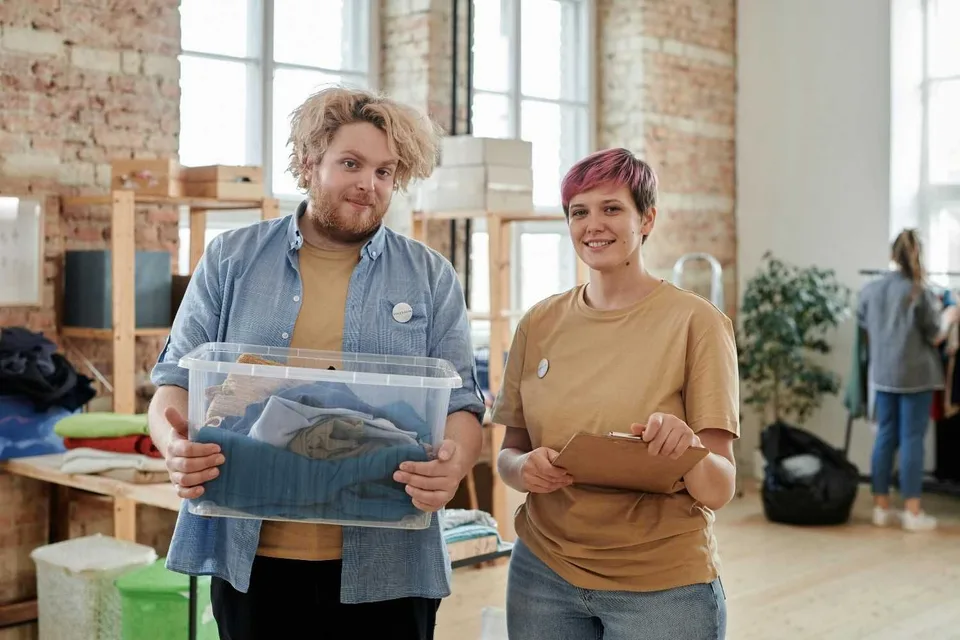
Zoom out from the policy detail and the tonnage figures, and the picture simplifies to something almost elegant. The biggest determinant of what happens to your clothes is not what brand made them, not whether they contain recycled fibres, not whether you bought them from a "sustainable" retailer. It is whether you put them in a donation bag or a bin bag.
Donate, and the odds favour reuse. Somewhere between 50% and 70% of separately collected textiles find a second life. The system is imperfect — quality is declining, export markets are strained, financial viability is precarious — but it works. Your clothes will probably be worn again.
Bin, and the outcome is near-certain destruction. Residual waste in London goes to energy-from-waste plants. There is no sorting stage. No one checks whether your jeans were still wearable. They burn alongside food waste and packaging, and that is the end.
This is not a story about personal virtue. It is a story about system design. When collection infrastructure is convenient and visible, people use it. When it is not, they default to the easiest option — and the easiest option, in most London neighbourhoods, is the bin.
What Actually Needs to Change
The instinct to focus on individual behaviour — buy less, donate more, repair what you can — is not wrong. It is incomplete. The system around those individual choices needs to function, and right now it is under serious pressure.
Collection infrastructure needs to be universal and convenient. Every London neighbourhood should have accessible textile collection points — not as a luxury, but as basic waste management provision. The London Textiles Action Plan's mapping initiative is a necessary first step, but mapping what exists is not the same as building what is missing.
Extended Producer Responsibility for textiles, which the UK is moving toward but has not yet implemented, would require manufacturers to fund end-of-life management. The industry blueprint proposes a 10p per garment fee that could generate over £300 million annually — enough to fund collection, sorting, repair networks, and recycling infrastructure. This is not a radical proposal. It is the logical consequence of recognising that the cost of managing clothing waste should fall on those who produce it, not on local authorities and charities operating at a loss.
And at the neighbourhood level, the emerging ecosystem of community clothing swaps, local resale networks, and circular fashion platforms represents something important: infrastructure that intercepts clothing before it ever enters the waste stream. A garment swapped locally does not need to be collected, sorted, exported, or processed. It simply continues being worn. These neighbourhood-level systems do not replace the need for large-scale infrastructure, but they reduce the burden on it — and they do something no industrial system can: they build the social norms and community connections that make circular behaviour feel normal rather than effortful.
The Real Measure of Progress
London does not have a recycling crisis so much as a collection and overconsumption crisis. The reuse system, while strained, still handles a substantial share of separately collected textiles. The recycling system barely exists yet. And the gap between what is consumed and what is recovered keeps widening.
Progress will not look like a single breakthrough — a new recycling technology, a landmark policy, a viral campaign. It will look like a thousand small shifts: more textile banks in underserved boroughs, more people choosing to donate rather than bin, more local events where clothes change hands, more repair services that are affordable and accessible, more visibility for the alternatives that already exist.
The fork in the road is still there, every Sunday afternoon, every time you hold something you no longer wear. The system behind each path is more complex and more fragile than most people realise. But the first step is the same as it has always been: knowing where your clothes can go, and making sure they get there.
Key Sources
- ReLondon, London Textiles Action Plan (March 2025) — developed with the Greater London Authority, London Councils, and the Ellen MacArthur Foundation
- WRAP, Textiles Market Situation Report 2024 — UK textile flows, value data, and sector financial analysis
- WRAP, Transitioning to a UK Circular Textiles Ecosystem Report — financial viability of the used textiles sector
- WRAP, UK Textiles EPR Blueprint — 10-point framework for Extended Producer Responsibility
- ReLondon, consumption-based emissions data for London (clothing = 17% of consumption goods emissions)
- DEFRA, household waste statistics and residual waste processing data